“No flag, no country! You can’t have one”

I first heard this line over two decades ago, when a friend introduced me to Eddie Izzard‘s comedic genius with a VHS of his show “Dress to Kill“. In it, Izzard is funnier than ever, as he puts his own spin on human history. He introduces the topic of colonialism with this memorable sentence:

“We stole countries with the cunning use of flags.”

– Eddie Izzard in “Dress to Kill”

You should definitely watch the rest of this sketch here, as only Eddie can tell it as it should be told.

Excerpt about flags, taken from Eddie Izzard’s 1999 stand-up comedy show “Dress to Kill”

I started writing this text last week, and now that war has broken out on the European continent, it seems sadly apropos. Personally, I have never quite understood how flags can trigger such strong emotions. In the case of the United States of America, most Europeans would argue that school kids pledging allegiance to the flag every morning is overdoing it a bit. But flags everywhere do awaken feelings that, outside of a war context, my mind cannot comprehend. This is not to say that these sentiments are necessarily negative. We all know flags can embody collective pride and freedom from oppression. But they have too often been waved to celebrate the freedom to oppress. Or the freedom to claim land for a people, even on the moon.

Flags (Source: Canva)

Flags representing groups other than nation states, for instance those whose rights have been violated, do not seem to have the same effect. For example, although the Romani people‘s or the LGBTQ+ Community‘s flags may rouse ardour among the people they represent, they are mostly used by these groups to highlight the recognition of their struggles and the celebration of their existence. But in the case of nation states, flags are inextricably tied to land ownership and a shared past. And when they are waved, it is mostly to ignite pride for victories over another nation, hence at another people’s expense. The Collins Dictionary’s definition of flag-waving confirms this sentiment:

Flag-waving in American English

1.  an effort to arouse intense patriotic or nationalist feelings by a deliberate appeal to the emotions

2.  a conspicuous show of patriotism

Collins Dictionary

That is precisely why I am uncomfortable with flags. This feeling may also be the result of my own background, with a German and Croatian heritage. Growing up abroad, I carried the inherited weight of the German flag which, although it is no longer the National Socialist flag, still bears the stigma of the unfathomable atrocities committed by Germans during Nazism. On the Croatian side, too, flags leave a bitter taste in my mouth. I have vivid memories of the context in which Serbian and Croatian flags were tied to tanks in the nineties, mere years after so many of the same people had cheered for the Yugoslav flag. (Oh, how quickly the masses trade one set of convictions for another!)

Whatever the reason for my discomfort, raised flags do generally serve to rekindle nationalisms and accentuate what divides us. And as another stand-up comedian, Doug Stanhope, pointed out:

Nationalism does nothing but teach you how to hate people that you’ve never met and take pride in accomplishments you had no part in.”

– Doug Stanhope

Doug Stanhope on nationalism and “saving the French”

Of course, not all who are attached to their flag are nationalists. Many see in it their bond with a community, which fulfils a fundamental need to belong. Sharing a common experience with a group of people can be very comforting, especially in times of relative isolation. But whilst patriotism places an emphasis on shared values and beliefs, nationalism rests on a shared cultural past, language, and heritage. This means that, by definition, nationalism excludes all who don’t share the same origins.

Its emphasis on heritage also goes hand in hand with any given group’s claim on the past achievements of their compatriots, whether living or long gone. And today’s successes of a handful of winners at competitions is celebrated by the entire community as their own.

What being a foreigner has also taught me over the years, is that people’s relationship with their country is like an extension of that to their family. Although most individuals will readily criticise their own state or countrymen/-women, any negative comment about their country by a foreigner, or alien, will be taken as a personal attack. One of the funnier examples of this was an experience I had while living in Birmingham. I once casually mentioned to my English flatmates that I didn’t like beans on toast, which set off a cacophony of xenophobic and nationalist statements. “Did I think my European grilled goat cheese in bacon sandwich was better than their English beans on toast?!” All of a sudden, our conversation wasn’t about food anymore, but about which nation was better than the other.

This universal discourse of what’s “ours” or “theirs” – with the implicit assumption that “ours” trumps “theirs” – was addressed in a documentary film entitled “Whose is this Song?” In it, director Adela Peeva goes on a search for the origins of a traditional tune sung in every Balkan country. Throughout her journey she found that, rather than bringing people together, the song was used as an excuse to divide communities.

Trailer of Adela Peeva’s documentary “Whose is this Song?”

Whereas I can’t understand strong emotional reactions to flags, I do have deep feelings and memories tied with music, food and dance. But even these three unifying elements, creating ties across all other cultural barriers, are being used by calculating leaders to add fuel to the flames of simmering nationalisms. My friends and I may not care whether the coffee we drink is Turkish or Greek, or whether we use Québécois expressions versus French ones, but there will always be someone there to point out dissimilarities and ask us to choose sides.

So where does that leave us lot, who just want to enjoy good company, food, music, and conversations, thus celebrating our ever-evolving group identities? While we try to build bridges between communities, great forces are working hard to shift popular focus back to flags and nationalisms. Away from the individual and his achievements, towards the group and its dangerous stupidity.

In the midst of disconcerting populist discourses on all continents, I think back on how puzzled we were by George W. Bush’s preemptive war in Iraq, back in the day. What a strange concept it seemed at the time, to attack another country because you suspect it might attack you. Offense being the best defence is a ridiculously dangerous notion. But if Bush Junior did it in 2003, using post-9/11 anti-Arab sentiment as ammunition, the same discourse will doubtless work elsewhere, in the aftermath of COVID and the 2008 financial crisis. For what better way is there to divert attention from the true causes of the wealth and power gap in our societies than flags?

Taken from art by Tijana Djapovic (c)

In order to be prepared for all possible outcomes of today’s multiple crises, all we can do is remain adaptable, keep our eyes and ears open, move the needle where we can, and be ready to react fast. I also intend to use my universal foreignness as an opportunity to acquire as many citizenships as possible, so that flags and borders can’t lock me in.

Meanwhile, whenever I want to take a step back and laugh at our human folly, I watch Eddie Izzard’s show again, as a faithful member of his flagless community of enthusiasts, who know the meaning of:

“Cake or Death?”

– Eddie Izzard in “Dress to Kill”

Here is your pathway to join the community: Dress to Kill – watch the show.  

(Title: Quote from Eddie Izzard’s “Dress to Kill”)

“The café counter is the parliament of the people”

Like most of my peers, I was recently infected with the dreaded coronavirus. Surprisingly enough, this turned out to be a blessing, in that it forced me off the hamster wheel and gave me back some time. Time to pause and reflect on our modes of communication. This was triggered by a search through the sea of podcasts for one that would consistently elevate my mind without feeling like a heavy lift. I stumbled upon a remarkable Serbian podcast, which manages a delicate balance of maintaining high quality while being pleasant to listen to for up to three hours per episode. Every week, the sharp and talkative creator and host of “Agelast” welcomes prominent individuals from a wide array of fields, ranging from actors to educators, from physicists to authors, to name but a few.

(The title animation for the podcast series “Agelast”)

What I have found interesting, aside from the audio content itself, is the realisation that over the last two years, I’ve been missing this sort of long conversation, organically flowing from one topic to the next. Most discussions in our lives have been taking place online, which comes with a certain pressure to be succinct and make a targeted point. This goal of being always as concise as possible is particularly emphasized in the work sphere and seems prevalent in north-western cultures. By contrast, the loquacious south-eastern part of Europe allows much more freedom to take time and improvise in conversations. The café culture is particularly strong in these countries, which can be felt even while listening to this podcast. There is room for verbal wanderings – which are highly underrated, considering the fact that they give birth to unexpected gems of thought.

I first recognised this southern cultural trait some 25 years ago in Dalmatia. There, I noticed that philosophy, politics and culture were everywhere, in conversations among ordinary shop owners, workers, pensioners. They would chat at length about the human condition and the universe, quoting Tolstoy, Jung or Descartes in passing. There, I found knowledge and philosophy in the streets to a far greater extent than in New York or London. This was probably, in part, thanks to the heritage of the extraordinary educational system in Yugoslavia. But I believe that what creates fertile ground for such interactions is also the slower pace of life and the ritual of spending hours sipping coffee with friends and acquaintances. Coffee is what you gather around rather than the object of going to a café. And the same creative results cannot be had by taking shortcuts or planning conversations like you would a bullet point presentation.

The measures that have been in place due to the pandemic have interrupted these fertile – albeit seemingly aimless – flows of thought for many. For my friends and myself, it has taken this abrupt break to realise how much our mental health is dependent on intellectual and emotional live stimulation. And though video calls are an acceptable temporary alternative to in-person conversations, they do not allow us the same degree of freedom and unwinding, which require time. Moreover, for many of us, this new reality has meant trading in personal time for work time which, in turn, has resulted in a steep increase in burnout.

Taken from art by Tijana Djapovic (c)

Whereas the term “burnout” is excessively used, it is rarely mentioned that some of the contributing factors are a lack of intellectual stimulation or challenges in the workplace. Pragmatically, we are encouraged to build our careers on what comes naturally to us, what we are talented at, because it is arguably the area that we can reach the greatest heights in by reinforcing our predisposed skills. But if you stick to what comes easiest to you, there is a risk of missing challenges. And where there is no challenge, there cannot be the same ensuing pride you experience upon overcoming obstacles. Hence the importance of possible upwards mobility in companies, so as to encourage employees to reach new heights and challenge themselves if they wish to. And if they do, adequate recognition must also be part of the system, instead of what we are seeing today, namely a carrot and stick scenario, in which only a lucky few will ever get the carrot. The faster you run after the carrot, the less headspace you have for thoughts that would, in turn, feed your creativity and help your mind and spirit grow in unexpected ways. But I digress, as I would in an in-person conversation…

Circling back to my initial point, I find that stopping the race for the carrot has helped me drop my blinkers. This regained vision of a vast horizon also means hearing voices that connect me with a broader world than my own. And where the humoristic and punchy lines of Stephen Colbert, Trevor Noah, Seth Meyers or John Oliver helped me deal with the COVID-world while I was in the hamster wheel, now that I’m off, the long slaloms of “Agelast,” artfully directed by Galeb Nikačević, put this whole experience back in the broader context of all that is human existence. And what’s more, this podcast has inspired me to end my evenings by reading books that have been waiting on my nightstand for months. Thus I would conclude that knowledge breeds knowledge – provided it is shared by the right catalyst.

(Title: quote by Honoré de Balzac)

“Should I stay or should I go?”

People everywhere are slowly resurfacing, after the COVID whirlpool engulfed us all, in one way or another. Since then, several of my friends have been echoeing what I’ve been reading about, namely that now, whoever still has a job should be so grateful, that they are expected to sacrifice everything to keep it.

A dear friend of mine recently asked whether she should stay at her current job, stick it out and keep hoping for a positive change – or whether she should get out before becoming cynical. I’ve decided to share her recent journey and dilemma on my blog, because her experience is a reflection of a general tendency I have observed over the last few years.

Ida is a passionate film producer, who traded her longtime exciting career for a more stable job in a young, dynamic and prominent lobbying organisation. Since she only moved to Belgium a few years ago, and has young kids to provide for, advising her to “throw caution to the wind” might not be the best advice I could give her.

After all, it is true that in this day and age, good jobs are hard to come by. Especially as a forty-year-old foreigner and mother of two. Jobs in organisations that awaken your enthusiasm, working with skilled and kind people are a rarity. And yet, even with such a job, staying is not necessarily the best option either.

During her first year in the organisation, whenever Ida spoke of it, it seemed too good to be true. She could hardly believe it when they hired her, though she was visibly pregnant. And yet, she still feared being fired afterwards, and suffered from the much-talked-about “imposter syndrome”. She thought that being hired must surely have been a mistake on the organisation’s part, as all her colleagues were performing so well and fast. But as time went by, she learned the ropes and got to the same level of productivity and quick thinking as her teammates. As I’ve often observed, mental agility is something one can reacquire quite easily, when motivated. So why should she leave?

Art by Tijana Djapovic

For one thing, even though she was promised a nine-to-five job, Ida regularly ends up working evenings and weekends. Even nights, since she had to take care of her kids after work.

Secondly, in spite of her initial impression that she was working in an organisation with a horizontal structure, the underlying hierarchy seems as present there as in any state administration. The day her manager told her, that he expected her to “make him shine” was the day she realised her chances of advancement were non-existent. Initially, she was led to believe that being ambitious was good, but this rule ended up only applying to management-level employees. Just as the old saying reminds us that “the fish stinks from the head”, one bad leader can ruin the experience of working in any organisation for the entire team.

Thirdly, as time went by, we all saw Ida’s enthusiasm crumbling, as she started seeing cracks in the structure and promoted ideals. For a while, she hadn’t seen them because, as an employee, she was made to feel that she was special. Like in any cult or totalitarian regime, she was repeatedly told how lucky she was to be working in such an organisation. All of us tried to warn her, that the friend we knew and loved was slowly disappearing. But the feedback she was getting at work was that she was “amazing” or “awesome”, which reinforced her perception of being in the best of organisations.

Taken from art by Tijana Djapovic

At first, Ida was thrilled to hear that her colleagues prompted her to “bring her authentic self” to work. But the definition of this authenticity, it turns out, needed to remain within the boundaries set by the organisation.

Like me, Ida has always been passionate about inclusion. So when she saw that this was a major point in their campaigns, she was overjoyed at the prospect of being part of the change she wanted to see in the world. Soon after, she realised that inclusion was only understood through the prism of narrow racial and gender issues. Members of countless underrepresenrted ethnic minorities targeted by systemic racism all over the world, were sorely missing across the board. As well as workers with disabilities, solo caregivers, employees over the age of 50 or talented and experienced individuals with no graduate degree.

I’ve often observed that the success of organisations or companies in today’s fast-paced world is built on hyper-dynamic, driven, young nonparents, ready to sacrifice their nights, weekends and mental health, because they are among the chosen few who are lucky enough to have a great job.

It is easy to buy into a shiny image and professed values, which echo your own. But when the honeymoon phase was over for Ida, and she discovered that the Great and Powerful Oz was an old man hiding behind a curtain, she had a hard time dedicating her energy and time to serving an illusion. In the end, our group of friends all gave Ida the same advice: in this instance, her mind should give right of way to her heart. And in her heart, she already knew that a steady paycheck and perks were lighter on her scale than daily abuse from a narcissistic boss.

Excerpt from “The Wizard of Oz” (MGM, 1939) when Dorothy, Toto and their three companions discover the Great and Powerful Oz.

Many of my friends are now in their forties. At that age, the prospect of climbing back up on the merry-go-round of job seeking isn’t thrilling. But it is the only right decision if you are truly unhappy at work, and still have the opportunity to regain your dignity and enjoy your time on earth.

I, too, have sometimes taken my time here for granted. But these two years of the COVID-19 pandemic partly isolated me from a broader and larger world, than that of productivity and practicality. Which is why I am following my own advice to Ida, and making time to reconnect with friends, family, my broader network of activists and artists – and myself. Both Ida and I have decided to go back to our own creative projects, and also make time for our kids.

And to document this post-COVID chapter, I am trading in my slick MacBook Pro for an old-fashioned paper notebook and pen. Back to the roots we go.

(Title: Song by the Clash)

“42 Up”

Some ten years ago, I watched a documentary film that had a deep impact on how I perceive life. It was entitled “42 Up”. It followed a number of Brits from different regions and social backgrounds every seven years, from the ages of seven to forty-two. I saw them go from being sparkly-eyed kids to awkward teenagers to responsible adults to middle-aged men and women. Some more ordinary than others, some happier, some more successful, some more fulfilled than others.

Seeing the result of this film, spanning over thirty-five years, left me feeling both amazed and sad. What I found in all of them was the inevitable loss of innocence that comes with age and experience. That also went with a loss of ideals in many. And loss of beauty as well. Today, at forty-two, I should watch it again and see how I feel about it. Or better still, I should watch the latest film in Michael Apted’s series that began with “Seven Up!” (1964), which is now “63 Up”. Somewhere along the line, the title lost its exclamation mark… which, incidentally, seems a perfect way to sum up the difference between the ages of seven and sixty-three.

In this COVID-19 crisis, I am fortunate to have a new job that I’m excited about, to have my wide-eyed child by my side, to live in a home and a neighbourhood I love, to be in regular touch with my loving family. But these times of relative isolation have also brought on a new wave of reflection which, combined with the Netflix content I’ve been watching (such as “Marriage Story” or “The Last Dance”) reminds me that life doesn’t turn out the way one expects. Ever. There are unexpected successes, joys, falls and pains. And while love and hope inspire and drive us, suffering and pain play a significant role in shaping us as well. I saw this in “42 Up”, too. There is so much we do – or avoid doing – for fear of being hurt.

(Taken from art by Tijana Djapovic)

Though I don’t believe that we are born as clean slates, I do see us as clay shapes that life hits, carves, moulds over time. Bit by bit, we evolve into complex beings, growing increasingly unique and different from each other, as life adds one texture after another to our initially smooth clay. At middle age, I perceive love and hope in my peers. But none has kept that initial innocence we all used to have. That faith that there will be a “happily ever after”. Because our lives have taught us otherwise. There is no “ever after” as such. There is only happy, then unhappy, then happy again, and so on and so forth. But over time, erosion makes us less affected or moved by unhappiness and happiness alike. Our skin gets thicker, we roll with the punches and we enjoy well-deserved rests after each round.

In this time of contemplation for the whole world, I do appreciate what I have. I also look forward to many more moments of happiness. Even though I know better than to expect what I imagine for myself to come true (in the positive or the negative sense), I do know that joy comes back to me after every struggle. But where am I right now? If I were to do my own “42 Up” recap of my life, it would probably go like this: At age seven, my world was enchanted, almost perfect. At fourteen, it was painful and filled with self-loathing. At twenty-one, it was hopeful and looking to the future. At twenty-eight, it was harsh but glorious. At thirty-five, it was awakened to what adult life is. At forty-two, it is unsettled and I am searching for steady ground.

(Taken from art by Tijana Djapovic)

For three years, I have been feeling like the earth under my feet has been shaking. And, like in a seismic zone, every time it stops, another earthquake rocks the ground I walk upon. And it isn’t easy to build on moving ground. But I have been fortunate enough to join a company built on the concept of constant transformation, flexibility and adaptability. And my travelling companion is a little girl who loves the circus so much, she now excels at finding her balance in any situation like a tightrope walker. What I must now learn from both is not to expect the ground to ever stand still, but rather to function and grow on moving ground. Perhaps by the next seven-year mark, my spirit will be as agile as my daughter’s nimble body.

(Title: Documentary Film directed by Michael Apted)

“It’s beginning to look a lot like Christmas”

Lately, I was working so hard, writing funding applications, discussing and developing my screenplay, that when going to bed at 4 a.m. I had a really hard time slowing down the wheels spinning in my head. So I started watching brainless family Christmas movies to end the input of stimuli to the brain. When I get to that level of mental overdrive, the only remedy I’ve found over the years is watching very silly movies. They bring me entertainment, a warm fuzzy feeling, and require no brain activity, while being engaging enough to keep your mind from straying.

Art by Tijana Djapovic (c)

However, over the last week or so, something has been bugging me with these films. Aside from bad acting – which is apparently a necessary evil in this genre – what I find frightening is the uniformity of the stories. That a certain type of message should be promoted in these films is a given. They do tend to glorify a lot of what, incidentally, was glorified in Nazi propaganda, i.e. traditional values, family, small communities as symbols of cultural health, country living away from the city’s “perversions” or “inhumanity”. Fortunately, not all the characters being portrayed are White Christians nor are all the values purely conservative. But what’s new and disturbing is the absolute uniformity of the so-called traditions that are being promoted in these films.

I’m no traditionalist, and yet, I consider that much of the beauty to be found in the world today stems from the great diversity that exists in our cultures. Growing up, I loved the fact that if we wanted real Dalmatian honey, we had to carry it back in heavy glass jars from our grandparents’ place, over in Croatia. I loved that the Northern German Christmas traditions we celebrated were not at all like the ones my Belgian classmates shared. And when our parents wanted to have good coffee, they made it in their old-style espresso maker, German coffee pot or Turkish cezve (or džezva).

Our grandmother playing German Christmas songs,
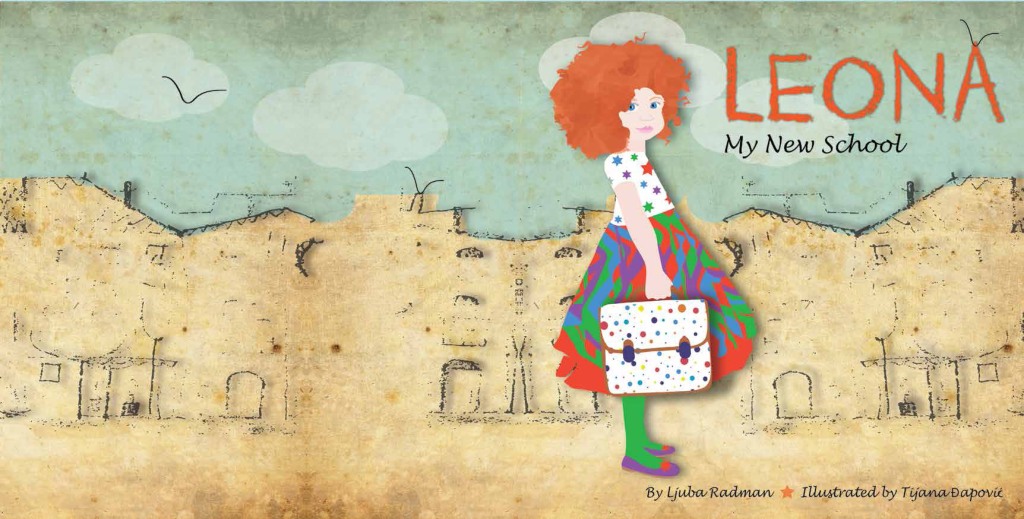
as portrayed by Tijana Djapovic in our children’s book « Leona » (c)

Now, not only do we all drink our Nespresso (what else?), from Singapore to Timbuktu, but our kids run around in monster costumes come Halloween, whether we’re in Belgium, Croatia, Germany – or Taiwan. I am by no means afraid of change, nor do I dislike having Nespresso instead of some of the brown juice they used to call coffee in Brussels cafés 20 years ago. But my question is “Why do we do what we do?”

Why indeed, do we celebrate a modern American-style Halloween in Brussels, Zagreb, Berlin? It’s not like the world outside the United States lacks authentic traditions worth passing on to our kids. On the contrary, we have plenty, but are letting them slowly disappear to be replaced by an all-engulfing Halloween (for example). I find the pagan ritual of Samhain, which became All Hallow’s Eve or Halloween, fascinating. But why does its commercialised version spread, whilst Bulgaria’s Baba Marta Day, Germany’s Saint Walpurgis Night or England’s crowning of the May Queen disappear? Not to speak of the thousands of symbolically strong traditions that used to be celebrated throughout the world. The answer is: because Halloween is big in the US. And the world copies American traditions, which are mostly a mishmash – or, at best, a mosaic – of old North-Western European traditions. So why not keep the original traditions instead? I wouldn’t be surprised if, in ten years’ time, my Belgian neighbours were to roast a turkey on thanksgiving day and plant American flags on their front lawn on the fourth of July.

I am all for mixing nations and cultures, opening up borders and letting traditions evolve. By definition, I am myself a mix of cultures and traditions. But I am distressed by the takeover and complete uniformisation of culture and traditions as a consequence of unleashed capitalism. The way we dress, the expressions and gestures we use are also a reflection of this tendency. When I see a Portuguese Belgian-born kid fist bumping with his buddies and adding the now common “Boom!”, I wonder if I’m in Brussels or New York.

Diversity in clothing 150 years ago, which has been replaced by t-shirts and jean’s.
Taken from “A pictorial history of costume” bu Dorine Van Den Beukel, Pepin Press, 1998

Very few things should, in my opinion, be unequivocally universal. Among them are Human Rights, animal protection, saving this planet’s ecosystem. But where the industrial world has succeeded in spreading mobile phones, bad R&B music videos and SUVs faster than the plague, the same cannot be said for gender equality or the protection of minors. So it is clear that this standardised monoculture I speak of is tied to money, rather than culture. 

In that sense, I’m hoping that Europe will fight back. If not financially, then at least culturally even at the lowest levels of culture. For starters by having its diversity portrayed in its own family films and series. In the hope that these will be watched as much as American ones are. Because even within the United States, local traditions are giving way to a predictable checklist of all-American “traditional Christmas” activities, including a tree-lighting ceremony, decorating gingerbread houses, ice-skating and a big jolly Santa Claus shouting out “Ho-ho-ho!” – regardless of whether you’re in Alaska, Utah, California or New Hampshire.

With that in mind, I look forward to lighting the first of four candles on my Advent wreath and watching my daughter open the first little window on her old-style beautifully illustrated (and chocolate-free) Advents calendar this December 1st. Those are two of our Northern German traditions I plan to pass on to my part-Croatian child, growing up in Belgium.

Et vive la diversité !

(Title: Song written by Meredith Willson)

“Meaningful connections between the subjective and objective world”

This is how Carl Jung described the phenomenon of synchronicity. These events, which seem directly correlated, without having discernible causal connection – and they are back in my life at full blast.

For several years, I felt as though the Universe was blocking my every move, sabotaging my every undertaking. The more I fought, the harder the blows I got were. Little by little, this series of perceived failures was wearing me down. The only option for me at that point was acceptance. This new state of my personal and professional affairs was what it was, and I had to live with it. I came to accept the fact that my days of shining glory and sparkling enthusiasm were behind me. This dug the path for a flow of self-doubt and self-deprecation that made its way inside me. Motherhood was the only part of my life that was still truly brightening my days. For the rest, I was going through the motions and watching the days go by.

Taken from art by Tijana Djapovic

During one more winter that felt as cold emotionally as it did physically, I started writing this blog. I wanted to practice writing and needed to see a concrete result of my thoughts. These thoughts that otherwise just kept rolling and tumbling inside my head. Putting words on my feelings of despair, self-pity, sadness, hurt, disappointment helped me in a way. By writing them down, these emotions seemed to be losing some of their grip on me, though I could not see objective changes in my situation. Until, one day, a window that had been shut was opened. And then another. And then it was a door. And then three windows and two doors.

Taken from art by Tijana Djapovic

Since this summer, a warm breeze has swept through my life and through the windows and doors of my soul. And what’s surprising is the return of the synchronicity I once knew. One might call it God’s winks, another might prefer to speak of serendipity or fate. I call it synchronicity because I cannot find a good reason why this should not have happened sooner (or later for that matter), so it doesn’t feel like it’s fated. But it is fascinating to see that, in contrast with the last two years, now my moments of doubt are met with a helping hand. My moments of tiredness are met with an event awakening the feeling of excitement in me. My efforts finally seem to be paying off.

“I can take you” by the Feminae et insula collective

What I’ve been experiencing is not the Hollywood success story or happy ending. It is not a final answer to any one prayer. Rather, it is a series of opportunities combined with a constant and discreet wind in my back. Now I can take a proverbial slap in the face and brush it off, I can look my detractors in the eye and think “I can take you!” There are still many aspects of my life that could do with serious improvement. But it has been much easier to get up in the morning, knowing that there are forces that seem to carry me instead of dragging me down. One friend told me that things happened exactly as they should and that nothing happens by chance. I don’t know about that. But I do know that, just as there are particular manifestations in nature occurring when the stars align a certain way, there is an ongoing series of positive events and encounters happening in my life. My very own happy constellation.

(Title: Quote by Carl Jung)

“The best is yet to come”

Lately, people around me have been telling me that they are convinced the best is yet to come for me. Why or how, I don’t know. Faith in a brighter future for oneself is one of those things that seems to slowly disappear with age.

Art by Tijana Djapovic (c)

Childhood was wonderland for me and, in my eyes, the world was a happy place. Adolescence was a very rude awakening to the darker side of human nature surrounding me. Then came the first chapter of adulthood and the discovery of my strengths and power. This was followed by the second chapter of adulthood, which showed me my limits and brought me to focus my attention on those I love. And now, it’s the third chapter of adulthood. I am still focused on the ones I love, but am gearing my attention back to myself as well, thinking: “Can what is to come really be as extraordinary as what I’ve lived so far?”

After having been starry-eyed, immensely ecstatic, after having created great beauty from scratch and moved mountains, after having experienced magic and had so much energy that it seemed endless… is it possible that what awaits me can compete with what was? Of course, common sense tells us that the future should not have to compete with the past. But that phrase, “the best is yet to come”, does imply that it is compared to what used to be. And this first question gives birth to another, namely: “Do you create your own happiness or does it come to you?” Some friends tell me I should stop thinking and just do: write, network, organise my time as best I can, do as much as I can during my waking hours, because action breeds reaction. Effort generates results, including positive ones. Meanwhile, other friends tell me to do less, to let go, to open up and have faith that what must be will be, that relaxing and welcoming change will bring it about effortlessly.

Taken from art by Tijana Djapovic (c)

The confusing thing is that my personal experience can confirm both affirmations. And neither. Over the course of my adult life, so far, I’ve noticed that when I set my mind to something, I usually did make it happen. The price to pay for that was always the problem: whether financial, emotional or physical, there was always a price to pay for my great ambitions. What my experience has also taught me is that every once in a while, when I would give up on pretty much everything and just accept the fact that I needed help, help would indeed come. I would have meaningful encounters and good things would be born out of them. But this time around, neither approach seems to work as it once did, because I am not the same person as I once was.

These days, I find I am juggling, wrestling, running, quitting, falling flat and getting back up on this court known as my everyday life. Where I had come to grasp the laws that governed the unidimensional universe I used to be in, I am struggling to see the logic of the multidimensional universe I am living in now. The pace of it all has increased, the layers of complexity have multiplied, I have difficulty distinguishing true faces from masks. What used to be true no longer is. And meanwhile, my motivation and stamina are out of breath. So I guess the best thing for me to do now is to just wait and see what tomorrow brings: a bull to take by the horns and ride into the sunset – or a hammock to stretch out in while waiting for the sun to shine on me.

(Title: Song written by Carolyn Leigh)